Quran Verses for Hard Times: Ayat to Return to When It's Tough
Short answer
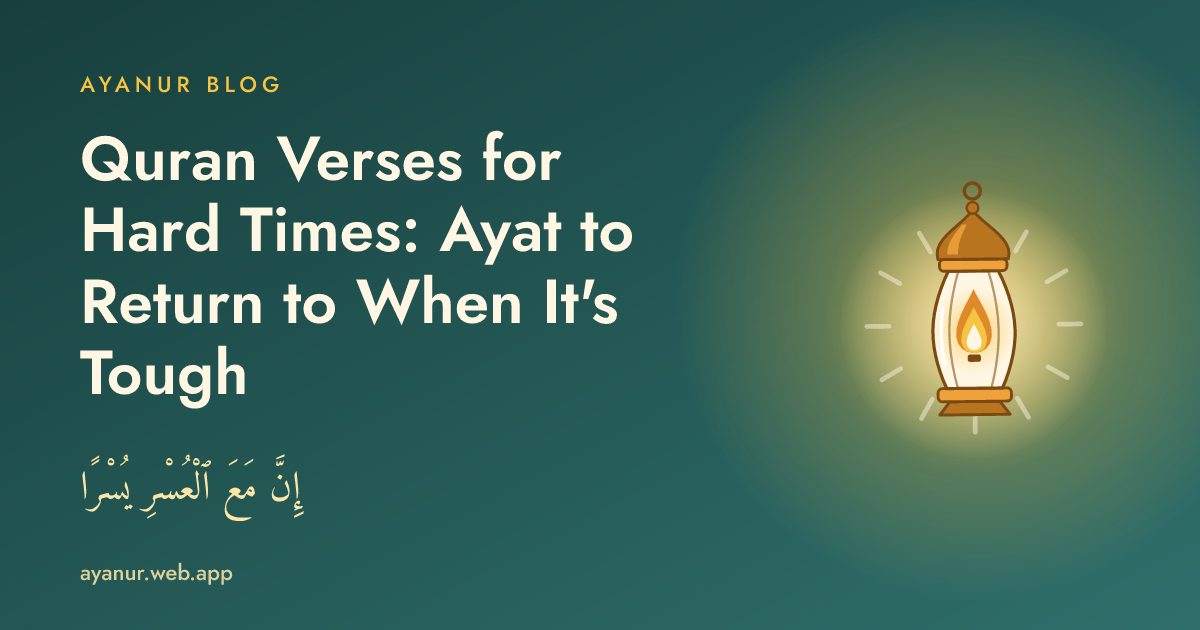
Many Muslims turn to a few short passages when life gets heavy. The most quoted are 94:5-6, which says that with hardship comes ease, 2:156, the words said when disaster strikes, 2:45, which asks for help through patience and prayer, and 12:86, where the Prophet Yaqub (peace be upon him) brings his grief to Allah. The verse about ease is quoted most often: "Indeed, with hardship [will be] ease." (94:6)
The answer in more detail
When a hard period starts, people usually look for a few verses they can hold onto rather than a long reading. Four passages come up again and again. Surah Ash-Sharh (94:5-6) reminds the believer that hardship is never the final word, because ease comes with it. Surah Al-Baqara (2:156) gives the words Muslims say when something painful happens: that we belong to Allah and to Him we return. Surah Al-Baqara (2:45) tells the believer to seek help through patience and prayer. Surah Yusuf (12:86) shows a prophet who was honest about his pain and still turned to Allah with it.
These verses are short enough to memorize, and that's part of why they stay with people. You can read one in the morning, repeat it when a worry comes back, or write it on a card. Each one addresses a different kind of hard time: waiting, loss, exhaustion and sadness that won't lift. Together they cover a lot of ground without needing any explanation.
If the difficulty is heavy or lasting, these verses are a source of comfort, but they don't replace support from people around you or from a professional when you need one.
Hard times come in different shapes. Some are a long wait for an answer, some are a sudden loss, and some are just a heavy week that doesn't lift. Muslims have always leaned on certain verses in those moments. Below are four that people return to most often, with a note on what each one says and where it's usually recited.
Ease comes with hardship (94:5-6)
Surah Ash-Sharh contains one of the most quoted lines for difficult periods. The verses speak directly to the Prophet Muhammad (peace be upon him), and the believer reads them as a promise that things don't stay hard forever.
فَإِنَّ مَعَ ٱلْعُسْرِ يُسْرًا ﴿٥﴾ إِنَّ مَعَ ٱلْعُسْرِ يُسْرًا ﴿٦﴾
5 For indeed, with hardship [will be] ease [i.e., relief]. 6 Indeed, with hardship [will be] ease.
The verse is short, and the repetition is the point: the ease is spoken of twice. People often use it when they feel stuck, because it names the hardship honestly and then says what comes next. It works well as a verse to say slowly, before a difficult conversation or a long day.
Words said when disaster strikes (2:156)
Surah Al-Baqara describes a group of people who, when disaster reaches them, say a set of words. These are the words Muslims recite when they hear of a death, an accident or another painful loss.
ٱلَّذِينَ إِذَآ أَصَٰبَتْهُم مُّصِيبَةٌ قَالُوٓا۟ إِنَّا لِلَّهِ وَإِنَّآ إِلَيْهِ رَٰجِعُونَ ﴿١٥٦﴾
Who, when disaster strikes them, say, "Indeed we belong to Allāh, and indeed to Him we will return."
The phrase "Indeed we belong to Allāh, and indeed to Him we will return" is often said quietly, sometimes in the first moment of shock. Many people learn it as children and find that, years later, it's the first thing they reach for. It doesn't explain the pain away. It places the loss within a larger truth that the believer trusts.
Seeking help through patience (2:45)
Patience is a theme that runs through the whole Quran, and Surah Al-Baqara ties it to prayer. This verse tells the believer to ask for help in a specific way.
وَٱسْتَعِينُوا۟ بِٱلصَّبْرِ وَٱلصَّلَوٰةِ وَإِنَّهَا لَكَبِيرَةٌ إِلَّا عَلَى ٱلْخَٰشِعِينَ ﴿٤٥﴾
And seek help through patience and prayer; and indeed, it is difficult except for the humbly submissive [to Allāh]
The verse doesn't say that patience is easy. It says that prayer and patience together are the way to get help, and that this is hard for most people. Many readers use it as a reminder to keep praying even when they feel tired, instead of waiting until they feel better.
A prophet who brought his grief to Allah (12:86)
In Surah Yusuf, the Prophet Yaqub (peace be upon him) has lost his sons and carries that grief for years. When people tell him to stop grieving, he answers in this way.
قَالَ إِنَّمَآ أَشْكُوا۟ بَثِّى وَحُزْنِىٓ إِلَى ٱللَّهِ وَأَعْلَمُ مِنَ ٱللَّهِ مَا لَا تَعْلَمُونَ ﴿٨٦﴾
He said, "I only complain of my suffering and my grief to Allāh, and I know from Allāh that which you do not know.
This verse is useful for readers who feel they should be stronger than they are. Yaqub doesn't hide his pain or pretend it's small. He brings it straight to Allah, and then says he knows things others don't know. Many people find permission to be honest with Allah in this verse.
Duas for hard times
Verses that describe patience are one way to use the Quran in a difficult period. Duas, the verses where believers ask Allah directly, are another. Surah Al-Baqara 2:201 is a dua that's often said in general times of need, because it asks for good in both this world and the next.
وَمِنْهُم مَّن يَقُولُ رَبَّنَآ ءَاتِنَا فِى ٱلدُّنْيَا حَسَنَةً وَفِى ٱلْـَٔاخِرَةِ حَسَنَةً وَقِنَا عَذَابَ ٱلنَّارِ ﴿٢٠١﴾
But among them is he who says, "Our Lord, give us in this world [that which is] good and in the Hereafter [that which is] good and protect us from the punishment of the Fire."
You don't need special words to make dua. Many people choose one verse like this, read it slowly and then add their own words in their own language. Asking in your own words is also a normal part of dua.
Making these verses part of your day
A list of verses is easy to read once and forget. Many people use a simple routine instead. They pick one verse for the week, write it on a card or in a notebook, and read it at the same time each day. When the hard feeling comes back, they already know which verse to turn to.
Some people also like to see a verse on their phone without searching for it. The Ayanur app has a home screen widget that shows one short ayah of the Quran with its translation, and the free version changes the ayah once a day. If you want a short verse to be there when you pick up your phone, that's one simple way to do it.
Frequently asked questions
What is the most popular Quran verse for hard times?
Surah Ash-Sharh 94:5-6 is quoted more than most. It says that with hardship comes ease, and the same idea is repeated in the next verse. Many people keep it close because it's short and easy to remember.
Which verse is said when someone faces a loss or disaster?
Quran 2:156 is the verse most often recited at a time of loss. It says that we belong to Allah and to Him we'll return. Muslims commonly say it when they hear bad news.
Is there a dua in the Quran for difficult times?
Yes. Surah Al-Baqara 2:201 is a well-known dua that asks Allah for good in this world and in the Hereafter, and protection from the Fire. Many people say it as a general prayer when they're struggling.
Can I read these verses when I feel anxious or sad?
You can, and many people find them calming. If anxiety or sadness lasts for a long time or affects your daily life, please talk to a doctor or a qualified counselor as well.
See an ayah every time you pick up your phone
Ayanur puts a short ayah of the Quran on your iPhone or iPad home screen and lock screen: the Arabic text, its translation in your language, and the surah and ayah number. It changes on its own through the day, even offline and without opening the app.
- Arabic from the Tanzil Project, unchanged. Translations word for word from QuranEnc.com, in 10 languages.
- Free: one home screen widget with a new ayah once a day.
- Ayanur Pro: a new ayah every hour or 3 times a day, every widget style, lock screen widgets and larger text.
Keep reading
-
Short Quran Verses in English: 15 Ayat and Their Meaning
15 short Quran verses in English with the Arabic and the reference, grouped by hope, trust, patience and gratitude, with a few lines on each.
-
Quran Verse on iPhone Lock Screen: Step-by-Step Guide
How to put a short Quran verse on your iPhone lock screen, why only short ayat fit, and the exact steps to set up the Ayanur widget.
-
Rabbana Atina Fid Dunya Hasanah: Meaning and Context
Rabbana atina fid dunya hasanah is the dua of Surah Al-Baqarah 2:201. Its full words, meaning phrase by phrase, where it appears and when it's said.